Escape the Ordinary
The Hudson Valley home of Calico Wallpaper founders Nick and Rachel Cope balances stillness with avant-garde moments, thanks to a collaboration with design studio General Assembly

US brand Calico is rethinking how people feel about wallpaper: from artist collaborations to must-see installations at Milan Design Week, its unconventional outlook merges the artisanal and the digital, and turns walls into canvases for creativity. Its founders, Nick and Rachel Cope, have also trodden their own path when it came to their home in Upstate New York’s Hudson Valley.

What began as a lockdown purchase has now become the family’s main residence, and it’s easy to see why. “From our very first visit, what struck us wasn’t just the architecture but the feeling of the place. The quality of the light, the surrounding landscape, and the sense of quiet all felt very special,” says Nick.
When they found the house, it was still fairly new (the barn-like structure with its long, low extension was designed by architect Erlend Neumann), but, wanting to put their own mark on it, they commissioned Sarah Zames and Colin Stief of General Assembly to make it feel more like an expression of their personal style.


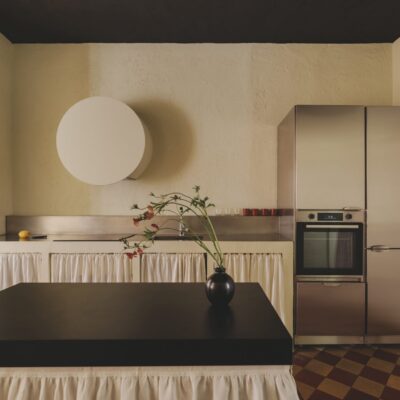
This wasn’t about a complete rethink, but a way to make the property the best version of itself. “Because the house already had such a strong architectural identity, we wanted collaborators who would build on what was already there rather than reinvent it,” says Nick. “The project became one of refinement rather than transformation: updating the kitchen and bathrooms, improving the infrastructure, introducing more natural materials and adding warmth through furniture, art and finishes. The goal was to make it feel unmistakably like our home while preserving everything that made us fall in love with it.”
The goal was to make it feel unmistakably like our home while preserving everything that made us fall in love with it


In the living room, dramatic corner windows offer incredible views across the rural landscape. The perfect globe of a huge Noguchi paper lantern fills the high-ceilinged space, with furniture including a Faye Toogood Roly Poly chair kept deliberately low so as not to interrupt the flow between inside and out.
Toogood is one of Calico’s collaborators, and her Woodlands mural – a dark fairytale of inky-black tree outlines – can be found on the walls and ceiling of Nick’s office. Elsewhere, the couple have looked to the calmer parts of Calico’s portfolio: in the dining room, the ethereal watercolour of Fragments wraps the walls and is framed by the open doorway leading from the kitchen, drawing the eye through the space.


Unadorned walls are just as much in evidence as wallpaper, however. “We didn’t want the house to become a showcase of everything we make. We approached each room individually, focusing on atmosphere rather than making a statement,” says Rachel. “In some spaces, the wallpaper becomes almost architectural; you feel it before you consciously notice it. In others, we intentionally left the walls quiet because the light, the materials or the landscape were already doing so much of the work.”
If these spaces change, and further work from Calico finds its way here, it will be because of the natural evolution of the house, not because the homeowners are slaves to whatever’s new. “We weren’t interested in constantly changing the house. We wanted it to feel settled and lived in,” says Rachel.


She says that the couple’s personal taste is for “spaces that reveal themselves gradually rather than demanding attention,” which dovetails with how General Assembly has presented this house.
Mid-century classics like the Wishbone dining chairs sit with some more avant-garde moments, like Toogood’s cartoonishly outsized Maquette 259 armchair, while the lighting is a roll call of brilliant contemporary US makers, acting like functional sculpture. One of Lindsey Adelman’s Knotty Bubbles pieces – amorphous blown-glass shapes suspended in a cradle of knotted rope – hangs over the kitchen island; Apparatus’ asymmetrical Trapeze wall light is fixed above a bathroom mirror; and Roll & Hill’s Atlas table lamp sits on Nick’s desk.

As many found during the pandemic, the pace of rural life – and deeper connection to the outdoors – stimulated creativity rather than stifled it. Rachel says that “being surrounded by nature changes the way you pay attention to light, colour, texture and the passing seasons, and those observations inevitably find their way into our work.
“Perhaps more importantly, it’s become a place where family life and creative life feel much more connected. The slower pace creates room for both, and that balance has been incredibly inspiring.”