Youth Q&A
Manchester studio Youth’s Liam McGroarty and Oliver Collinge talk about how their signature aesthetic of ‘refined rawness’ has defined every project – including a sublime new Cotswolds hotel opening, Hyll

DESIGN ANTHOLOGY UK: How did you two meet? Would you say your skills are complementary?
We met at the Manchester School of Art and, almost without realising it, began shaping ideas together from the start. They were small at first – nothing significant – but they planted a direction we didn’t yet know we were walking toward.
DA: Lots of designers claim not to have a house style, but Youth definitely has a signature aesthetic. How would you describe it?
We often describe our aesthetic as ‘refined rawness’ – a balance of honest, imperfect materials set against soft tones and textures. It’s the tension between the unpolished and the precisely detailed that creates our strongest work. That contrast feels alive, human and quietly powerful.


DA: Tell us about Hyll, the Cotswolds hotel that’s just opened.
We’ve delivered the full scheme – guest rooms, event spaces, wedding venue, restaurant, bar, breakfast suite and even brand direction for the landscaping.
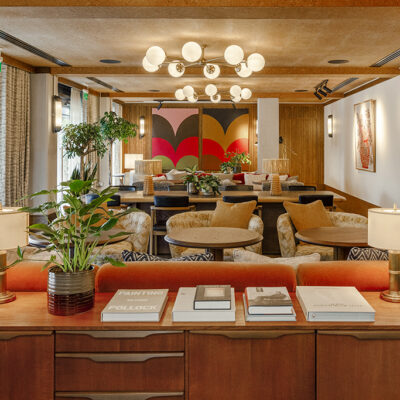
The brief was simple: do nothing. The aim was for guests to feel as though they could drop their bags and fall asleep in a chair. We stripped everything back, revealing the building’s natural features and layering warm, organic materials. Lighting was key – shifting through the day to make each space calm and inviting. It’s a project where the Youth thread runs throughout, offering something different to the Cotswolds: a retreat that feels deeply personal, not staged.
DA: Are there some highlight design moments at Hyll?
The transitional bar-restaurant area captures the essence of the scheme. It shifts from intimate, low-lit evenings to bright, open mornings with ease. The palette is tactile and grounded – chalky whites, muted greens, warm timber – paired with lighting that responds to mood and time of day.
We collaborated with craftspeople for bespoke pieces that tie the interiors back to the local landscape. Every choice is there to make the architecture breathe and the guest feel at ease.


DA: What have been some of the milestones or turning points in Youth’s history?
In the early years, it’s easy to take on work that doesn’t quite fit your vision. A turning point for us was deciding to be more intentional – to seek out projects that truly aligned with our aesthetic and values. Over time, we’ve been fortunate to attract clients who come to us because of our style, not in spite of it. That’s when the work deepened, and the brand found its centre.
DA: You work across lots of different sectors, from retail to workplace and hospitality. How have you managed not to get pigeonholed?
We approach every project – whether it’s residential, hospitality, workplace or brand – with the same starting point: how should it feel to be here? Our aesthetic is defined, but our process is adaptable, shaped by the behaviour, rituals and atmosphere each sector requires. That’s what keeps our portfolio varied without losing our identity.
We aim for spaces that shift with the moment: from dark, intimate corners to light-filled morning spots. Spaces that let you transition through moods without even thinking about it

DA: How do you want the spaces you have designed to make people feel?
The truest measure of success is seeing people use and enjoy a space exactly as we imagined – especially those who might not consider themselves ‘into design”. We aim for spaces that shift with the moment: from dark, intimate corners to light-filled morning spots. Spaces that let you transition through moods without even thinking about it.
DA: Is there a particular project that exemplifies your approach?
General Store [part of Manchester’s Deansgate Square development] is a great example. We fused the everyday familiarity of a corner shop with the detail and finish of high-end retail. It shows how we can take the atmosphere and sensory cues from one sector and translate them seamlessly into another. The result was both commercially successful and well-received in the press.

DA: What else is coming up?
We’re working on Trinity, a high-end residential development in Manchester; City Link, a co-living scheme in Croydon; a boutique hotel in Fulham; and two workplace projects in beautifully restored Manchester mills. Each carries its own brief, but all share our commitment to atmosphere and detail.
DA: What’s your own studio like in Manchester?
Our studio reflects us – tactile, layered, and built around our materials library. We work with samples constantly; they’re part of how we think and design. The space also doubles as a venue for brand events, so it’s flexible: part workshop, part meeting place, part gallery. It’s where ideas live before they go out into the world.
DA: And what’s the city like as a creative community right now?
The creative community here is thriving, with more and more successful brands emerging. We recently completed the rollout of the Adanola store in Selfridges and Harrods – a strong reflection of the scale of brands coming out of Manchester.