Folded Form
The new V&A East designed by Irish architects O’Donnell + Tuomey renders the gallery's silhouette as something distinctly different from its cultural neighbours
Walking through the concrete expanses and miserly triangles of green that comprise Stratford’s Queen Elizabeth Olympic Park, often hailed as the greatest legacy of the 2012 London Games, makes one regret the warren of factories and warehouses swept away in its making. The completion of East Bank – a tightly packed terrace of four cultural institutions overlooking the park, sharing a common podium and a sun-catching terrace along the River Lea – promises to enrich the Olympic legacy immeasurably, generating energy and excitement, and recovering some of that discarded creativity.
Two of this cultural quartet opened last year: a towering concrete block uniting the previously dispersed London College of Fashion by intelligent establishment architects Allies & Morrison, and the more convivial Sadler’s Wells East (the first east London venue for the famous dance company) by revered Dublin-based practice O’Donnell + Tuomey. Despite their very different physiques, both buildings explore the area’s industrial heritage, the former with gridded windows to light its workshops; the latter with engineering brick and sawtooth roofs. The third offer, BBC Music Studios – a more restrained modernist effort again by Allies & Morrison – will launch next year as home for the corporation’s live music, including the BBC Symphony Orchestra.

Loosely united by a palette of cast materials, all are a cut above the surrounding commercial and residential developments, but a vibrant creative quarter needs something more than polite industrial references. For the final project at the northern end of the terrace, O’Donnell + Tuomey was given a more expansive brief: to design an arresting yet inviting structure, giving a strong identity to a new V&A outpost geared towards young audiences from east London. The result is a distinctive five-storey pavilion that leans sharply away from the significant bulk of the neighbouring London College of Fashion, carving out room for its own distinctive aesthetic and the desired approachability, even as further residential towers rise alongside.

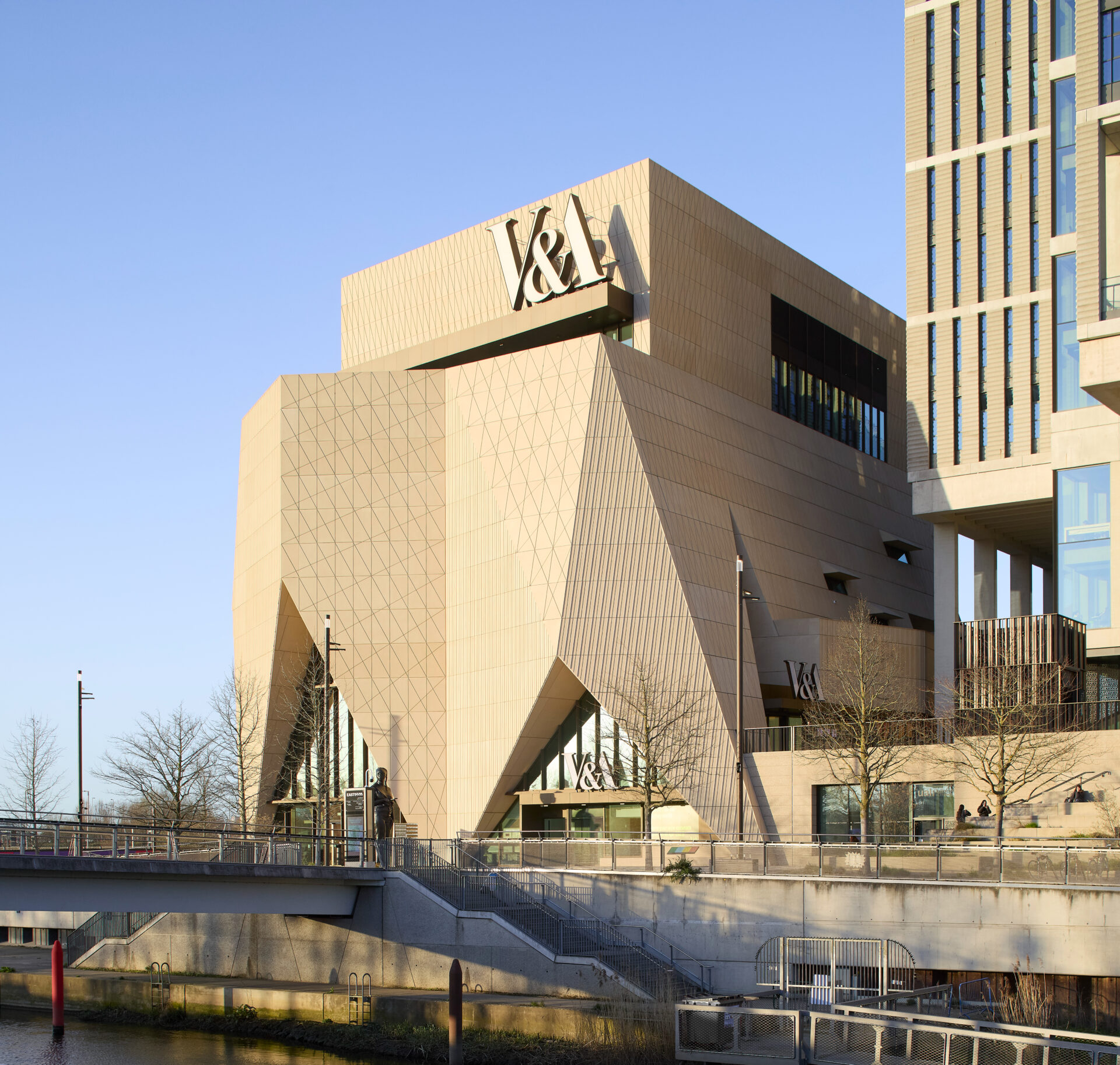
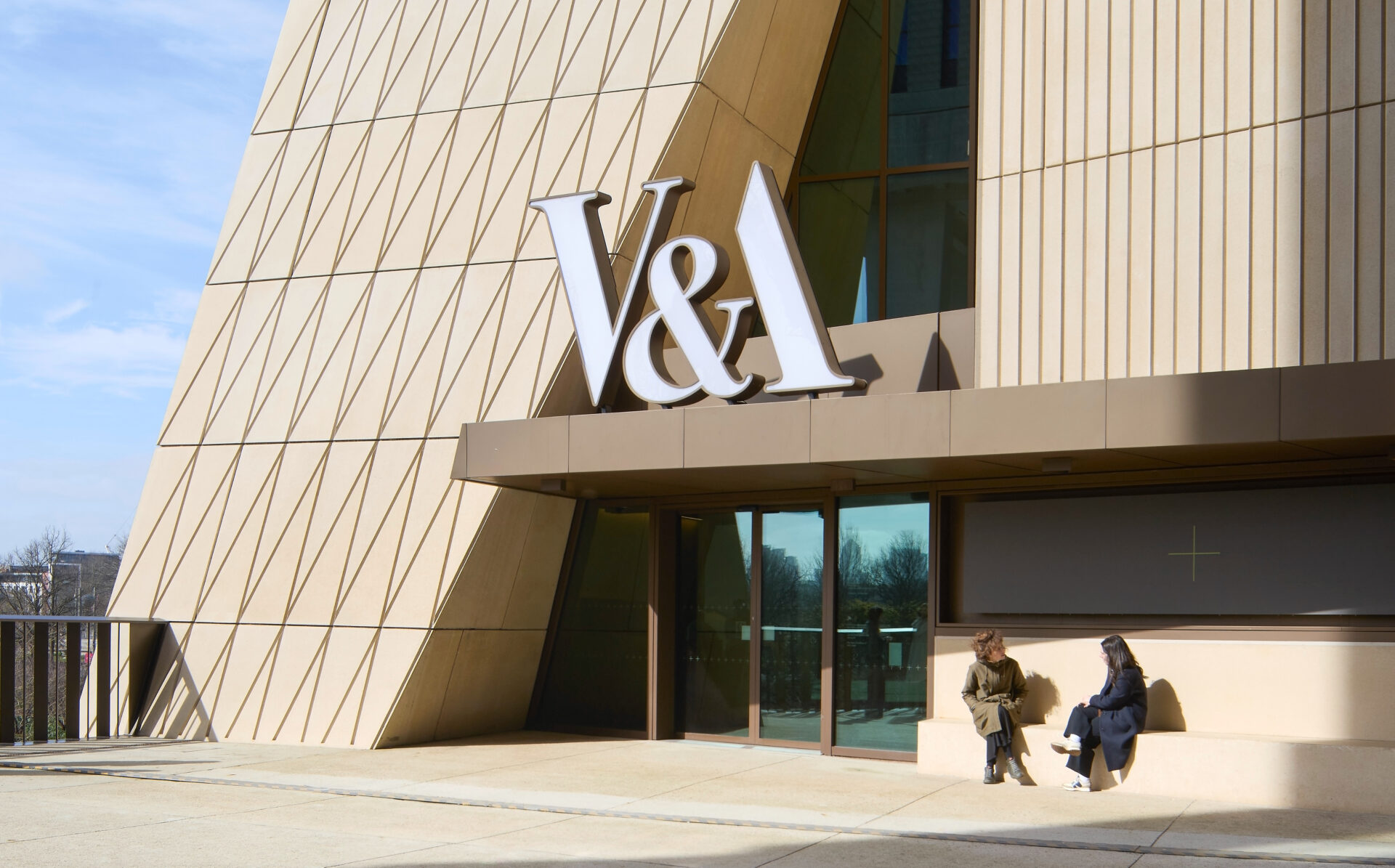
Two major references shaped V&A East Museum’s striking folded form. Firstly, the diagonals extracted from the V&A’s elegant logo, designed by Alan Fletcher in 1989, and prominently displayed on all facades. Secondly, the stiff tailoring originally noticed by practice co-founder John Tuomey in a painting by Johannes Vermeer at Dublin’s National Gallery, and later in X-rays of Cristóbal Balenciaga’s dresses displayed at the V&A in 2017. Employing boning, hoops and weights, the Spanish couturier contrived skeletal structures that created a void between body and fabric, evoking the Japanese concept of “Ma”, or “the space in between” – coincidentally, a theme also explored by Fletcher.

These influences are expressed via 479 precast concrete panels, each uniquely shaped, some as much as 14 metres wide. Carefully crafted in workshops, they were slotted together on site to form the building’s geometric exterior, incorporating a pattern of ridges and indents that catches the light, animating the building as the day passes. Hanging on an elaborate steel skeleton, this sandy-coloured “jacket” stands proud of the internal structure, its opacity protecting the upper-floor galleries from light. At the base, it is lifted up “on its toes” to create triangular openings where daylight, staff, visitors and delivery trucks enter, and the lively café spills out onto the terrace.
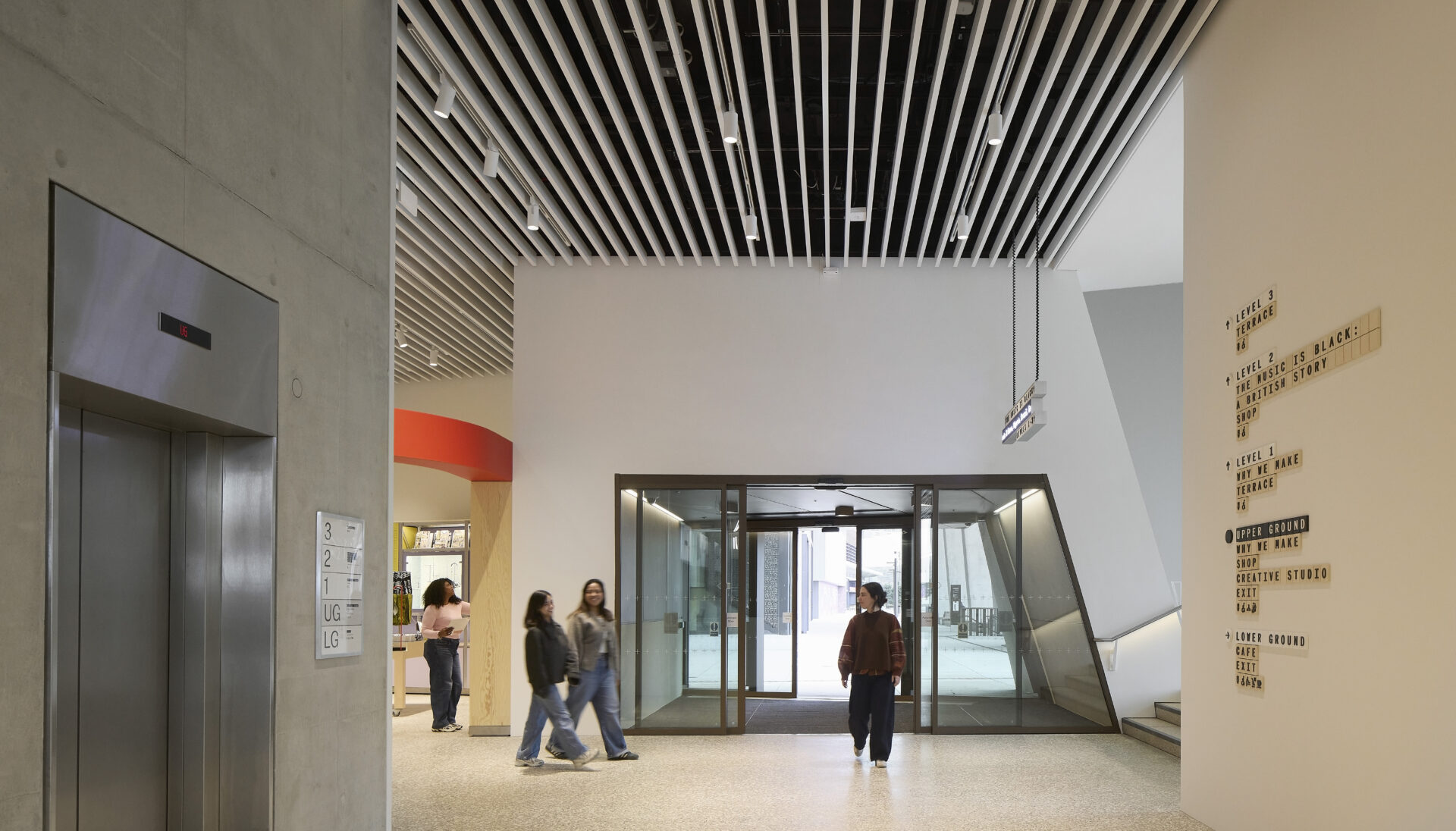
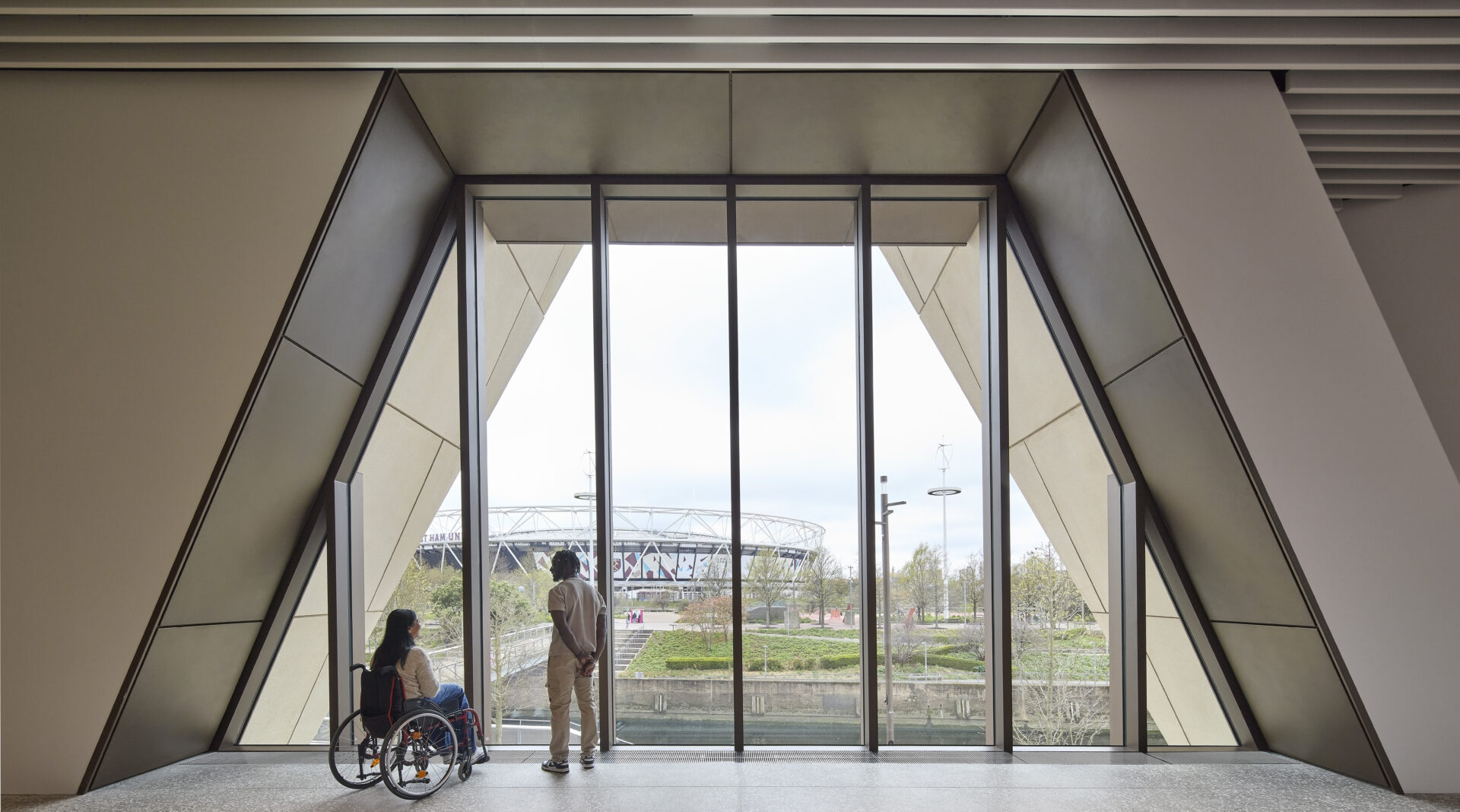

Heading inside, each floor has a stark white atrium that accommodates revenue streams such as shops or the café, and necessities such as lifts and lavatories, as well as the occasional objet d’art, from a Theaster Gates clay vase to a Ron Arad concrete stereo. Vertical circulation is provided by the enjoyably angular staircase encompassed within the concrete jacket, intersecting with intermittent windows with built-in seats to enjoy the view. These atriums feel a little spartan, perhaps deliberately so: by evoking public space, physical or psychological barriers to entry are minimised. This “railway station” vibe is reinforced by the building’s multiple entrances and the robust terrazzo running across floors and stairs, folding upwards to form the occasional bench. The sparsity also allows room for ongoing “New Work” commissions, such as the alluring stained-glass window by Cuban artist Tania Bruguera, embellished with statements on the civic museum’s role in society today.
The main galleries pose the greatest challenge. Each on a separate floor, these hangar-like spaces are essentially enclosed service areas – “trees in which the birds come and build their nests” in the words of Tuomey – offering slatted ceilings and little else. The difficulty is most evident in the main exhibition space at the top, where the photograph-heavy displays of the current show, The Music is Black: A British Story, chronicle the origins, stories and impacts of Black British music. These powerful expressions of creativity and resistance feel overwhelmed by their double-height surroundings, like temporary stands at a trade show. Some might feel that this functional exhibition setting is preferable to flamboyant Edwardian chambers or confined modernist boxes, but designers will need to work their limited budgets hard to conjure other worlds in an environment so inconducive to fantasy.
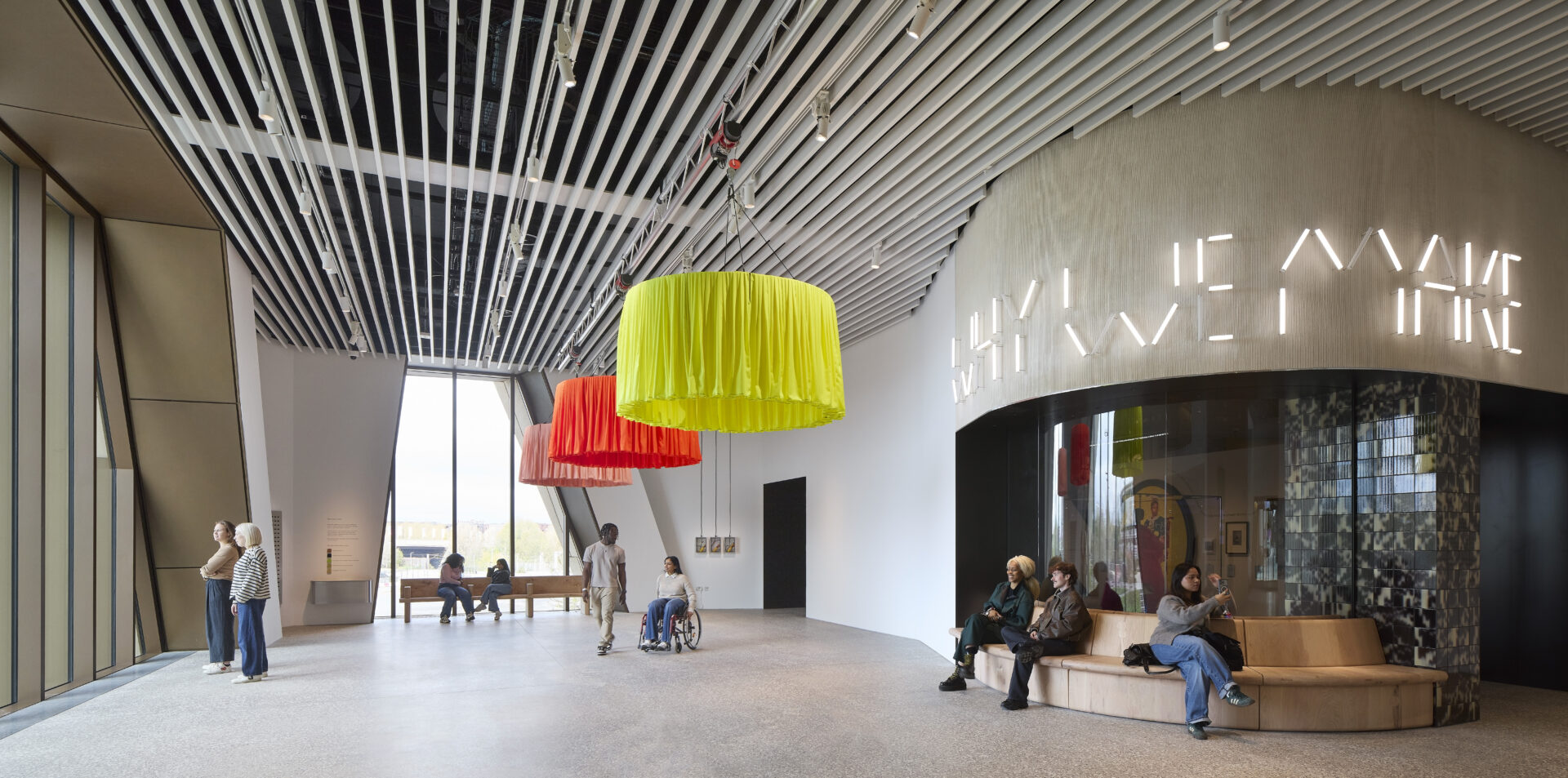
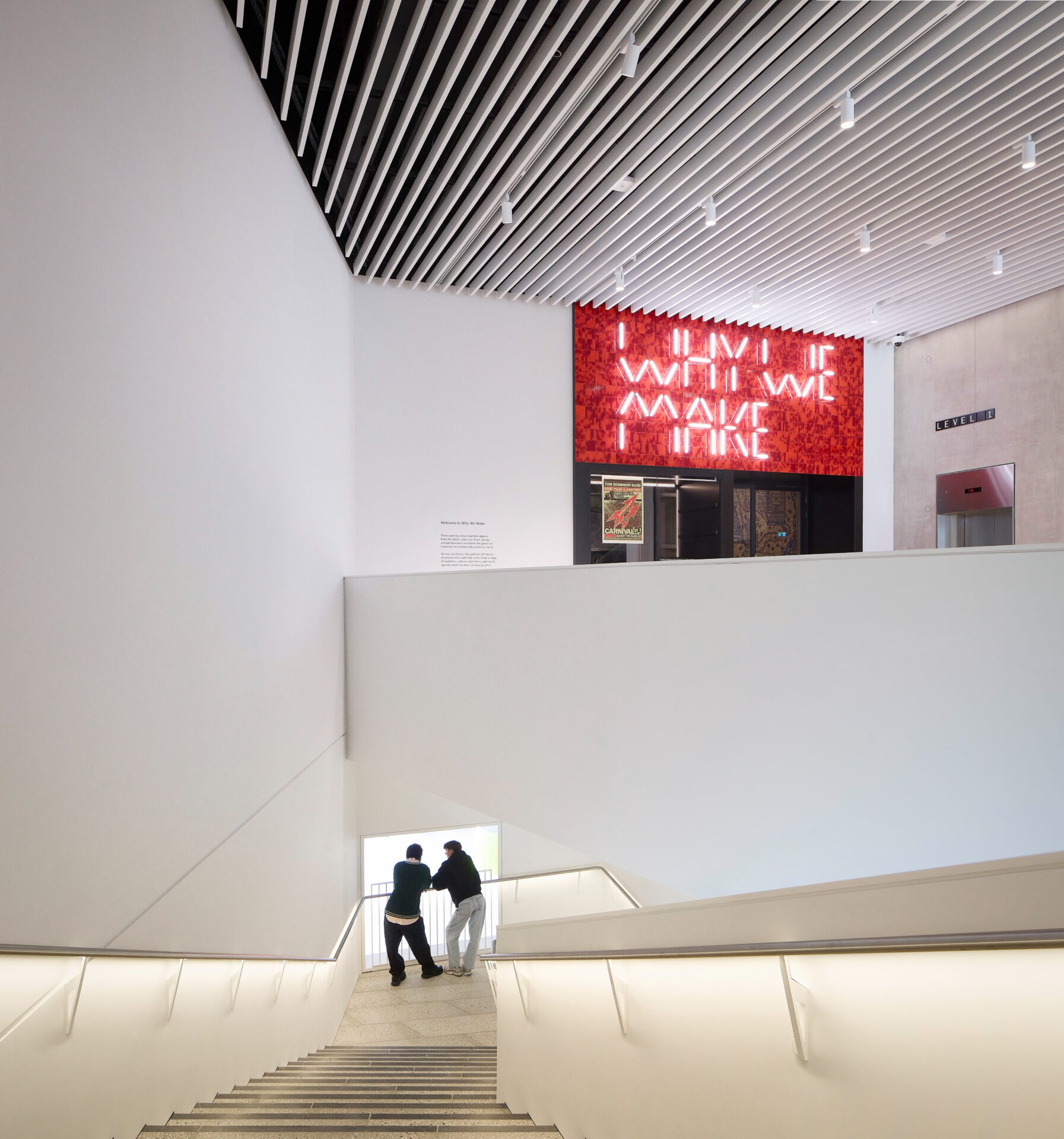
The two smaller “Why We Make” galleries below, displaying over 500 objects from the V&A’s permanent collection, make a better fist of things. Designed by JA_Projects, along with artist Larry Achiampong and graphic designers A Practice for Everyday Life, they are intended to evoke urban spaces – high streets, markets, malls, parks – encouraging self-propelled meandering rather than rigid routes. The deconstructed neon signage stands out, as do robust wooden benches inlaid with local motifs by Andu Masebo. Layout and programming reflect the ideas of local 18- to 24-year-olds consulted as part of the V&A East Youth Collective, with the goal of devising displays that both engage visitors and communicate design’s potential to drive change.
The exhibits cut across chronology, geography and outputs, with architectural models, DIY manuals, rolls of fabric, shisha pipes, protective amulets, community zines, data maps, potato peelers and ballet costumes all here. The lower gallery focuses on making as a personal act: self-expression, identity, storytelling, decoration, therapy, with a brief dip into our place in the universe. The top galleries take an activist stance, with ‘R’ words dominating – reimagining, revealing, recycling, repair, reuse, respect, revolution – in a dogged pursuit of relevance that occasionally palls.
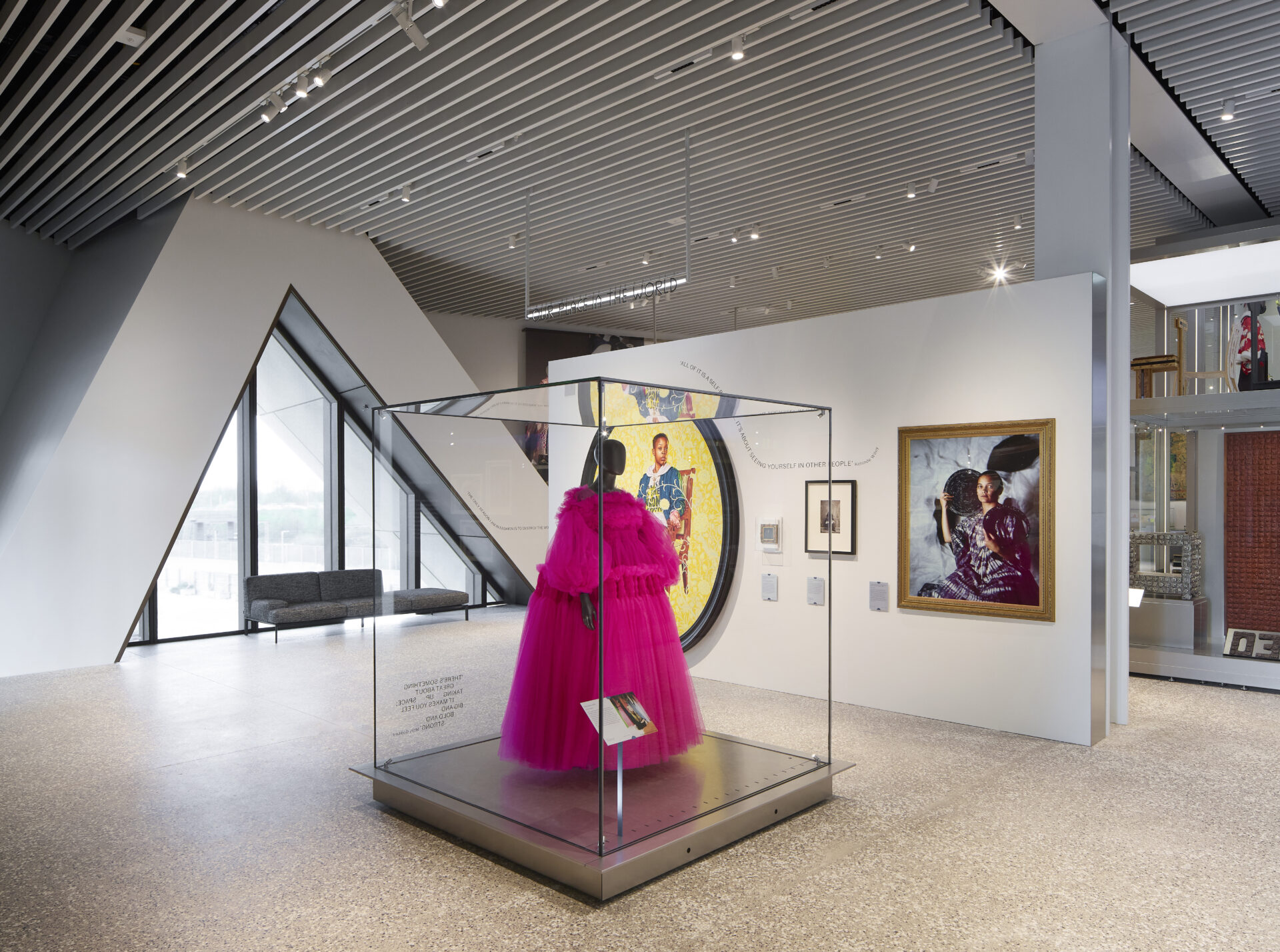
On the whole, however, the rich accumulation of diverse objects and stories is highly effective. Examples old and new are corralled to draw parallels between the therapeutic ambitions of Alvar Aalto’s Paimio armchair and sixteenth-century Belgian garden tapestries, or between the moral forces driving Morris & Company in 1890s Merton, Asha Sarabhai’s Raag Studio in 1970s Ahmedabad and Assemble’s Granby Workshop today. Familiar names are here – Eileen Gray and Rei Kawakubo, for instance, are paired as unconventional, entrepreneurial self-starters – but the displays travels far and wide, from salmon-skin weaving in eastern Siberia, to the intricate symbolism of Daoist robes, to furniture made from discarded bicycles by Chinese designer Xinyu Weng. If this medley of ideas and objects fails to spark the intended creative urge, we may as well give up and go home.
Right at the top of the building, a broad terrace provides wonderful views westwards over London’s constantly evolving fabric. The capital’s state of flux is also highlighted in the adjoining event space, where Marion Davies and Debra Rapp’s photographs of the Lea Valley taken in the run up to the Olympics are on display. They capture some of the industries and artisans that the Games pushed aside, ranging from die-cutting, belt-making and salmon-smoking to glass-firing, car-crushing and set-making. Gentrification and deindustrialisation were always part of the Olympic bargain, and from this perspective, the V&A’s current efforts at sparking fresh creative endeavours are as much delayed restitution as progressive vision.
Understandably, immediate judgements of V&A East Museum have focused on its appearance. Some have labelled it “chunky”, “a bit weird”, “a reconstructed Toblerone”, even just plain “ugly”. Others, including myself, are grateful for its architectural bravery. With its sculptural form and restrained interior, it is the opposite of last year’s acclaimed V&A East Storehouse by Diller Scofidio + Renfro, located just ten minutes’ walk away. Half a million items are stored there in the Olympics’ old media centre, clad in a spruced-up shell that would be perfectly at home in some out-of-town business park, but with a spectacular new atrium inside, its tiers of open-access galleries offering a sense of the infinite.
When it comes to grand projects, London has a fear of risk, of ambition, of appearing gauche. Tastefulness rules, and expression is an opportunity for ridicule. V&A East Museum may not entirely pull off an illusion of couture, but it achieves impact, intrigue and presence, and lifts its surroundings simply by being different. Just outside stands a monumental bronze by Thomas J. Price of a young woman – “an amalgamation of images, 3D scans and observations of local people” – looking up from her mobile phone “out to a horizon full of possibilities”. The choice feels a little safe – perhaps some graffiti might not go amiss – but further adds to the strong sense of place growing in East Bank, drawing the students, staff and visitors lounging on the benches and terraces around me, basking in the sun. Many of them are chatting about which objects they enjoyed, which ideas they might take away, what they might explore next – which seems like a pretty good Olympic legacy to me.