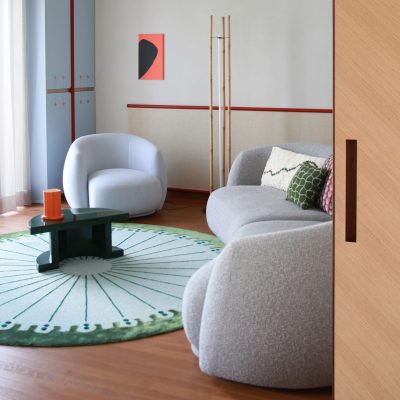
Polish New Wave
Polish design goes under the spotlight, showcasing the bold, intricate and innovative talent coming out of Warsaw

Arguably, it has been decades since Poland made an international splash culturally. The Polish People’s Republic, as it was called when part of the Soviet Bloc, the country was insulated from unwelcome Western influences for decades. Even so, the rebellious, world-renowned, 1950s and 1960s Polish School of Posters movement created abstract, surreal posters that subtly critiqued the Soviet Union – and influenced graphics and poster design worldwide.
Now Poland is witnessing another renaissance in design, shaped by sociopolitical and socioeconomic influences, among them Poland’s postwar history, entry into the EU in 2004, as well by as a renewed interest among its designers in long overlooked national crafts. An efficient manufacturing infrastructure and booming economy are also fuelling this rebirth. Since the end of 2019, Poland’s GDP per capita has grown almost 18 per cent, nearly twice as much as that of the US, according to a recent report in The Sunday Times.


In Warsaw, oppressive Stalin-era architecture remains omnipresent. Yet new contemporary cultural institutions are injecting optimism into the city’s arts scene. Now standing opposite the ornate, towering 1950s Palace of Culture and Science is the purpose-built, ultra-minimal Museum of Modern Art, designed by US architect Thomas Phifer, which opened last year – a riposte to Stalin-era bombast.
“For me, the most significant phenomena have occurred over the past few years,” says Basia Czyżewska, a design writer and contributor to the magazine Vogue Polska Living. “The Museum of Modern Art opened in central Warsaw, situated between a shopping mall and the Palace of Culture and Science. And the recently established Visteria Foundation has organised exhibitions that allow an international public to discover new creators and makers.” The foundation was established by Katarzyna Jordan, publisher of Vogue Polska and owner of publishing house Osnova. It held the exhibition, Romantic Brutalism A Journey into Polish Craft and Design, during Milan Design Week this year.

Polish design has enjoyed a great deal of exposure in London of late, too. For the London Design Festival (LDF) this year, artist Alicja Patanowska created her installation, The Ripple Effect, in the John Madejski Garden at the Victoria & Albert Museum. Constructed from hand-made sky blue or copper-coated ceramic tiles – partly made of mining waste from southwest Poland – it was a comment on the hidden costs of the extraction of natural resources to the environment. And Mint Gallery’s LDF exhibition, Second Skin, included work by Polish designers Aleksander Oniszh, Formsophy, Marek Bimer and Kaska Harasym.


Poland’s design scene has become more international thanks in large part to the country’s accession to the EU. “Many designers currently active on the market were educated abroad and are part of an international design community with experience gained in some of the world’s best-known studios,” says Magda Jurek, founder of Pani Jurek, a studio that specialises in ceramics based in Grójec, a town about 60km from Warsaw. One of its striking designs is Pola – wall-mounted, colourful ceramic tiles inspired by Op Art and monumental murals created by modernist designers. “We’ve been part of a free Europe long enough to feel like equal players, so we’ve shed our old inferiority complex.”
Marcin Rusak is one designer with international connections – he studied at the Design Academy Eindhoven in the Netherlands, then at London’s Royal College of Art. He is represented by the international Carpenter’s Workshop Gallery. His work is inspired by his botanist grandfather and the beauty of Poland’s countryside. His designs include tables with resin tops in which a profusion of blossoms is trapped; these recall Dutch still lifes and Shiro Kuramata’s 1988 Miss Blanche chair (save that the petals embedded in the latter’s acrylic frame are fake).
Patanowska, who trained as a potter, studied at the Royal College of Art. “A key development in Poland after the year 2000 was the growing recognition of designers’ names – brands in their own right,” she observes. “This was pioneered by academics and curators. In the 1990s, by comparison, designers were mostly anonymous, working in the world of industrial design.”


Poland has long excelled at producing functional furniture and for decades has been stereotypically associated with this rather than with creative flair. But now designers increasingly make hand-crafted furniture. Jakub Przyborowski creates minimal mahogany furniture in his studio in Praga, a neighbourhood in east Warsaw. He is president of the Nów. New Craft Poland Association, a group of independent craftspeople from all over Poland. “Warsaw stands out as Poland’s main centre. There’s a lot happening here – exhibitions, promotional events, new galleries,” he says. “But Poland has other important hubs including Łódź, Gdynia and Wrocław,” he adds.


“I think Warsaw became a hub for designers from all over Poland because it’s the only city with a decent amount of galleries and institutions that support contemporary design,” says Aleksander Oniszh, who creates sculptural wooden furniture with oscillating contours hewn from single pieces of timber. “But now other cities are catching up.”
Where to see contemporary design in Warsaw
Craftica Gallery
Founded by Anna Woźniak-Starak in 2024, this promotes Polish design and crafts. It is part of the Starak Family Foundation, an institution she and husband Jerzy Starak established in 2008 to support young artists and designers.

Objekt Gallery
Co-founded by Aleksandra Krasny and Marcin Studniarek, this caters to Poland’s growing appetite for collectible design. It represents glass artist Filomena Smola and ceramicist Monika Patuszyńska, among others.


SĀR Concept Store
This shop, co-owned by Julia Piekiełko and Piotr Niemyjski, stocks lighting and mirrors by Pani Jurek and the work of glass designer Agnieszka Bar, among others.