Fettle Q&A
To mark ten years of their hospitality-focused design studio, Fettle founders Andy Goodwin and Tom Parker reflect on collaborating across continents; the design ingredients for the perfect restaurant; and some standout projects

DESIGN ANTHOLOGY UK: Your studios are in two continents, London and Los Angeles: how does that work in terms of the communication between them?
Andy Goodwin: Tom and I catch up most days and are in constant communication. Typically, Tom oversees projects in the US and South America from the LA studio and I would oversee projects in the UK, Europe and the Middle East from the London studio. Tom acts as a sounding board on the works that we produce in London and vice versa, and we try to be as fluid as possible and arrange the resources to best suit the requirements of the project. Whenever possible we open initial ideas for projects to both studios to generate lots of early ideas.


DA: How have you built on each project, and is it important to you to keep learning in order to thrive?
Tom Parker: Due to the nature of our dual locations we have projects in a great variety of countries and cities. The benefit here is that we come across suppliers local to all of them. For example, we currently have a restaurant project in Big Sky, Montana within the US studio and are working with a fantastic millworker (joinery company) local to the project. They in turn have access to many more local materials and suppliers than we would be able to track down ourselves so the whole process becomes a great learning opportunity for us and applies whether the project is in Big Sky, Paris or Mexico.
Having had the studio now for a decade, Andy and I gain a lot of joy and inspiration from this – it it would get quite stale and repetitive quite quickly otherwise, so on a personal and professional level that continued learning, development and evolution is important to us.

DA: The last decade has been a tumultuous one for running a business. How have you weathered the various storms, and were there any high and low points?
AG: There have certainly been some challenging periods over the past decade and we feel incredibly fortunate to have had the studios grow and go from strength to strength through these times. We have our clients to thank for work remaining relatively consistent and benefit greatly from our ability to complete work in very different markets thanks to the dual locations we work from.
There have been so many highs over the years; however the completion of 1 Warwick in Soho, and The Georgian in Santa Monica, are particular highlights, given the hard work that it took to get them over the line. Covid was a huge change for the studio and although it felt tough at the time, we developed new ways of working and have come through this stronger as a result.
The more flexible nature of work has led to people being able to travel and work at the same time, so it's incredibly important that spaces are flexible and adaptable

DA: Restaurant group San Carlo is one of your repeat clients, with a new opening on London’s Piccadilly, Cicchetti. With this latest outpost, what is unique to the project, and what is part of the wider San Carlo brand DNA?
AG: It is an evolution of the design language that we have used with the brand in the past. The client team wanted to ensure the space was bright and playful, picking up on the work that we previously completed at Isola [on St Christopher’s Place] while retaining the overall design language of Cicchetti in Knightsbridge.
The majority of elements in the space were developed specifically for the site, including the bar design with a Red Jasper bar top, checkerboard tile infill and checkerboard burr veneer undercounter as well as the staggered arch back counter with mirrored reveals. The greeter area is designed specifically for the space as is the bar flooring, bar stools, fabric scheme, wall and ceiling lights; while a major feature of the restaurant itself are the bespoke églomisé mirror artwork panels that are used throughout.


DA: You’ve also just completed an aparthotel, The July, in London’s Victoria. It’s highly multi-functional – does that say anything about where hospitality’s heading?
AG: This is our first hotel in London, which feels very special to us. As an apartment-hotel, the space has to be truly multifunctional to give guests the space to work, rest and play in the same surroundings and this was central to the brief from the outset.
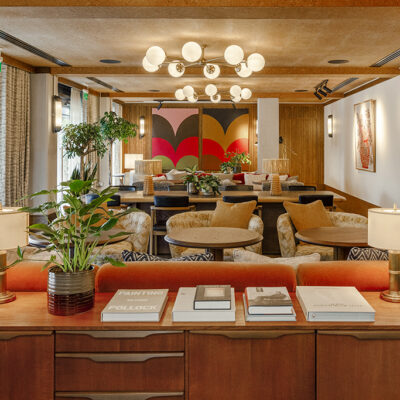
From the [wider] briefs that we receive, it is clear that a huge number of projects that we work on require the flexibility to ensure that they are suitable for different times of the day and for different purposes. The more flexible nature of work has led to people being able to travel and work at the same time, so it’s incredibly important (in many of our hotel or members’ club projects specifically) that spaces are flexible and adaptable.
DA: What else is coming up?
TP: In the UK we are completing our first European-based Casino. In the US, as well as opening Sirrah in the Meatpacking district (our first project in New York), we are also going to complete some long-term work with the Robert Redford-created Sundance Mountain Resort, where we have designed a very rustic, mountain-inspired boutique 64-room lodge.

DA: How much of good hospitality design is about the invisible elements – from chair heights to acoustics and using durable materials?
TP: The invisible things are key for allowing the visitors to be able to enjoy the more visible and tangible elements. At Sirrah, we have been working with a specialist company that provides very high-specification acoustic fabrics for architectural finishes and drapery. The client, September Hospitality, has partnered with a speaker company to make the restaurant have a more club-like feel – but without us getting the acoustic treatments of the space right, nobody would be able to enjoy the visual elements or even the food and beverage offering.
DA: What are some of the essential, non-negotiable design ingredients of a great restaurant?
AG: All elements are important, but getting the layout right is absolutely essential to the space working well to create the best environment for guests. Operational flow is also critical, as well as the matrix of seating, before we can start addressing the atmosphere that we are looking to create.
The other key element we focus a lot of attention on is lighting. Great lighting is so important in creating atmosphere, and layering the lighting allows us to ensure that the spaces we design can be utilised at different parts of the day for different occasions.

DA: What are you like as a regular punters in a hotel/restaurant?
TP: Given that both Andy and I have kids now we are normally just absolutely delighted to make it out of the house! On a more serious note, we certainly approach new places with a relatively critical eye but at the same time this also gives us the ability to really enjoy hospitality experiences and appreciate the dedication other teams have put into them. We spend a week every year together in New York seeing new spaces – eight to 10 every day – and it’s the best way for us to stay inspired and come across exhilarating and novel new concepts.
DA: Are there any new frontiers you’d like to tackle in the next decade?
AG: Tom and I have always dreamed of working on a smaller boutique hotel where we are able to design each of the guestrooms individually, all built around an experiential F&B experience – ideally located in the South of France or on the Amalfi coast!