Charles Zana Q&A
Ahead of his In Situ show in Paris, taking place in a grand Rue de Rivoli apartment from 21-26 October, French designer Charles Zana explains why this is the most personal and daring presentation of his work to date – where bold architectural scale meets Parisian history and intimacy

DESIGN ANTHOLOGY UK: In Situ is taking place in a Directoire reception apartment on rue du Rivoli. How did the setting shape your approach to the exhibition?
CHARLES ZANA: The setting is everything. It overlooks the Jardin des Tuileries, and its enfilade of windows seems to breathe Paris in, framing the city in a suspended, almost theatrical moment.
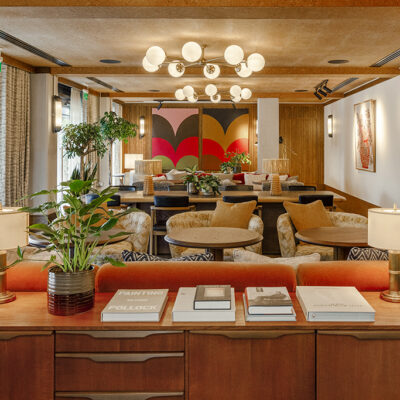
The apartment was once the Cercle Suédois [Swedish cultural centre] and carries a history of grandeur and intellectual exchange. I wanted to amplify that resonance by creating an atmosphere that feels both monumental and intimate – sculptural yet natural, as though the pieces had always been part of the apartment’s soul. The scale of the rooms encouraged me to push furniture into more sculptural, even architectural, dimensions, while the scenography had to feel inevitable and harmonious, as if the works had always belonged there.


DA: Why did you want to create a feel that was less staged, and more lived-in?
CZ: Interiors should never be frozen tableaux. They are spaces to inhabit, to breathe, to move in. Rather than staging an artificial décor, the idea was to compose an environment that is vibrant and inhabited, where the visitor feels the energy of life as much as the beauty of the objects.
DA: Does In Situ mark a shift in your work?
CZ: Absolutely. After Ithaque and Iter [the last two major shows in Paris], which were about departure and journey, In Situ is the arrival – the moment of belonging. It’s more personal, more daring: scale, fantasy, freedom. Compared to those earlier exhibitions, for In Situ I amplify the sculptural language of my furniture in a maximalist way, exploring scale and volume with more freedom and affirmation.
It is the culmination of a trilogy: after the journey, here we are “within the walls”. Furniture becomes architecture; objects verge on sculpture.


DA: What are the key pieces on show?
CZ: There are more than 30 works, most newly created. Among the highlights are the Sara sofa, deliberately oversized and double-sided, conceived to be used from both sides, like a small piece of architecture redefining how we inhabit a room. A monumental bronze chandelier, conceived as a sculptural constellation of intertwined forms, is another key piece anchoring the space. Surrounding it are lacquered collectors’ tables in sepia brown, saffron yellow and sage green, as well as coffee tables in pewter, wall lights in plaster, and reimagined pieces in brushed wood, travertine and cast glass. Ceramics and tactile surfaces add further rhythm. I love extremes: from the intimate to the monumentally commanding, together they form a landscape of contrasts and dialogues.
DA: Have you reimagined pieces on a larger scale simply to fit the venue, or as a response to wider demand?
CZ: Both. The architecture inspired the scale, but there is also a cultural appetite. In grand spaces, furniture can and should take on an architectural role, as in the 1970s when sofas and tables defined entire interiors. Collectors today want statement pieces: sculptural works that anchor spaces and express identity, personality and vision, not merely functional objects.


I love extremes: from the intimate to the monumentally commanding, together they form a landscape of contrasts and dialogues
DA: You’re introducing lacquer, pewter and ceramic in this collection – what drew you to these materials?
CZ: Like the decorators of the 1930s, I like to revisit ancient techniques and reinterpret them in a contemporary vocabulary. Lacquer fascinates me for its depth and tactility: we developed three bespoke colours inspired by nature and the Greek islands. Pewter, with its soft matte finish, evokes Parisian bar counters and brings unexpected sensuality. Ceramic, like rattan, carries authenticity and tactile warmth. Each material brings rhythm and emotion, adding new layers to my language and expanding the sensorial register of the collection.
DA: You’re also showing pieces from your personal collection alongside your own work – what can we expect?
CZ: There are 19th-century paintings around Eugène Carrière, Carlo Mollino’s Polaroids, ceramics by Ettore Sottsass and sculptures from Galerie Chenel. Carrière’s misty, monochrome paintings evoke dreamlike tenderness and psychic depth, and he was a Symbolist pioneer who influenced Fauvism and Picasso’s Blue Period. Mollino’s Polaroids reveal eroticism, secrecy, architectural flair and an obsessive gaze. These inspirations converse with my own creations, revealing memory and invention intertwined, and embodying the dialogue between classic and modern, intimate and universal – the very dialogue that nourishes my work. Showing these pieces is essential because they reveal my sources of inspiration and my eclectic sensibility.


DA: Craftsmanship is central to your work: how do you choose collaborators?
CZ: Collaboration is at the heart of my process. Ideas are born in dialogue – with my team, but also with artisans. France has an extraordinary heritage of craftsmanship, and I feel deep loyalty to those who accompany me. I work with upholsterer Charles Jouffre in Lyon, whose mastery of tradition and constant reinvention inspires me, and with Maison Charlois in the Nièvre (which are barrel makers, historically), with whom I designed raw oak stools shaped from the vocabulary of lumberjacks. What I look for is not just technical excellence, but passion, curiosity and the boldness to push limits. They bring tradition and reinvention through dialogue – where our ideas find shape.
DA: Where would you like to explore next?
CZ: I am drawn to glass – a material I have long admired but not yet embraced – and to larger scales, where furniture is scaled like architecture. I want to continue expanding my vocabulary of materials, seeking inspiration in traditional techniques but reinterpreting them in new ways. Each project is a new departure: I remain open to residential, cultural and hospitality contexts because travel and discovery keep pushing me forward.

DA: Do you think that your work has a definitively Parisian sensibility? How would you define that?
CZ: Yes, I believe so. I would say I’m Parisian to the core. Parisian style is not defined by a single look, but by a cultivated eclecticism – refined yet never rigid, always in dialogue between past and present. In a Parisian apartment, a Jean Royère armchair can sit beside an 18th-century commode, or a contemporary photograph above a plaster wall light, and it feels effortless. It is this freedom – mixing antiques with contemporary design, rigour with fantasy, allowing humour and sensuality to enter – that defines its spirit.
For me, Paris is not one style but a constant dialogue of contrasts: the aristocratic elegance of the 6th (Saint Germain), the intellectual spirit of the 5th (Quartier Latin), the raw, popular energy of the 11th, the artisanal ateliers of Bastille and the dazzling world of the great fashion houses in the 8th. My work carries that tension within it – between workshop and grand residence, between craftsmanship and refinement, intellect and fashion, tradition and modernity. That alchemy of opposites, layered over centuries of savoir-faire, is what makes Paris unique, and what shapes my sensibility.
In Situ is at 242 rue de Rivoli, Paris 75001, from 21–26 October 2025